Monday, September 24, 2012

Opening Up America


  In 1803, America was just a small collection of states from what had once been the original 13 colonies. At that time, Europe was embroiled deep in war. Napoleon Bonaparte had conquered much of Europe and had won the Louisiana Territory from Spain three years earlier. Americans, seeing how powerful France was becoming, feared that France would invade them, too. But in 1803, Napoleon began to feel the costs of war. Napoleon had just lost a major battle and wanted to take over Great Britain. To gain money for his new strategy, Napoleon sold the Louisiana Purchase to the United States. President Thomas Jefferson paid $15 million for the land---about 5 cents per acre! Why did Napoleon give the U.S. such a deal? Like many tyrants, Napoleon wanted to conquer the world. Just because he sold the Louisiana Territory to the U.S., didn't mean he could not conquer it later. Fortunately for us, Napoleon lost his war, and thanks to him, the U.S. was well on its way to becoming a great nation.

  What might have happened if the French did not sell us this land? Can you imagine this area being a French-speaking country and the U.S. being very small? It is hard to imagine, isn't it?

Thursday, July 28, 2011

Kindle Books Available


We are pleased to announce that The Orphan and the Beaten Drum and The Orphan and His Golden Bars are now available in Kindle editions that you can easily download and read on your PC or Kindle. These editions allow us to offer them without the cost of paper and ink! If you are interested, please visit Amazon.com at the link listed below. The cost to download is only $4.99.

http://www.amazon.com/Orphan-Beaten-Drum-ebook/dp/B005EOTC9W/ref=sr_1_2?ie=UTF8&qid=1311914056&sr=8-2

http://www.amazon.com/Orphan-His-Golden-Bars-ebook/dp/B005EVBXH4/ref=sr_1_1?s=digital-text&ie=UTF8&qid=1311914113&sr=1-1

Tuesday, March 8, 2011

¿Quién tiene razón?


I mentioned in a previous post about the Mexican-American War. In Mexico, there are still strong feelings against America's alleged aggression of their weaker country. Americans are still being decried for acting as war-like aggressors in areas such as Iraq. Perhaps the insults come with the territory of being one of the most powerful nations in the world.

Well, in our age of diversity and multiculturalism, many don't have a problem with admitting America was wrong. After all, Americans are always wrong, aren't they? Yet, let us not be like the park ranger I met in Brownsville who maintained “my country right or wrong.” Reasonableness requires that we examine the true nature of any conflict and decide who is right or wrong based upon unequivocal laws of right and wrong---the laws nature is governed by. If our country was wrong, we should own up to it. The only problem is that the unequivocal laws become very blurry in the Mexican-American War.

Mexico did not gain independence from Spain until 1821, and this late birthday must be kept in mind when considering that Mexico's government was still very unstable twenty years later. Additionally, the northern state of Tejas y Coahuila, with its sparsely populated and unproductive land, was very different from the Mexican interior. Its residents were American immigrants (mostly Southerners who brought their States' Rights doctrine) and very independent Mexican natives. In 1835, Santa Ana federalized the Constitution and took away the rights of Mexican states, causing the residents of Texas to separate just as Mexico had done from Spain.

The confusion around the end of the Texas War for Independence is what led to the Mexican-American War. Santa Ana, the Mexican dictator, signed the Treaty of Velasco, ending the war and ceding to the Texans all the land they desired. The problem was this: Santa Ana was deposed from power a few months before. Therefore, the Mexican government saw the treaty as void. This is how the “disputed territory” that would fuel the Mexican-American war came about. After Santa Ana signed the dotted line, hostilities stopped. While the Mexicans did not continue to fight, they maintained a spirit of “we will get you later.” The Texans lauded the end of the war. In 1845, however, Mexico arose to dispute the territory granted to the U.S. in Santa Ana's Treaty.

Do you get it? I admit that it is complicated. In the Mexican-American war, both sides fought for what they believed to be their rightful territory. By viewing the above map, you can see just how much territory was disputed by the Treaty of Velasco. Only then will you realize just how big of a deal the war was. In fact, the disputed territory was more than the whole state of Texas originally was!

So, how do we decide who was right and who was wrong? First off, the Texans had a right to do whatever they wanted to do with their state and territory. Did they want to separate to form their own country? Fine. Did they want to join the U.S.? Who can tell them what they can and cannot do? Mexico, however, refused to accept the democratic aspirations of the Texans, and even threatened to invade Texas should they become part of the United States! Even though the Mexicans had just seceded from Spain in a bloody war for racial equality, they denied the Texans the same rights of self-government and self-decision. Sound familiar? Yep, that's exactly what our government did to the South during the Civil War. It was wrong and belligerent for Mexico to forbid a sovereign nation (Texas) from entering the United States. Indeed, Mexico was trying to coerce a small country (Texas) and then complained about being coerced by the U.S. Funny how we are blind to our own faults.

It was, after all, Mexican troops who fired on a small body of men between the Rio Grande and the Nueces. This was disputed territory, after all---not universally accepted Mexican territory. The U.S. soldiers had just enough right to be there as the Mexicans did. It is also fair to say that the Mexican government was short on integrity when it stopped fighting in 1836 but wanted to push the issue again in 1845 after nine years of R&R. Does silence constitute agreement to Santa Ana's treaty terms?  The Mexican governments were full of corrupt dictators during these times who rose quickly and fell quickly. Was it America's fault that Santa Ana was declared an illegitimate ruler only a few months before the treaty was signed? You may judge.

Mexican proponents claim that America took advantage of a small nation. My reply is that Mexico holds just as much blame as America did for starting the war. IT WAS NOT AMERICA'S FAULT THAT MEXICO HAD WEAK AND CORRUPT GOVERNMENTS any more than it is America's fault that Mexican governments remain weak and corrupt today. If Mexico was weak, she sure matched her weakness with pride when she refused to see an American diplomat to negotiate terms. When reading many Mexican defenses of the war, one cannot help but think the authors are whining about their own calamities. It was not America's fault that their own Mexican governments had let them down or that the Mexican people suffered because of their own rulers.

That said, the American government was not free from the war-guilt. The Texans back in 1836 should have made sure all their t's were crossed and i's were dotted before they claimed victory. Additionally, the 1840's was a time of romanticism and excitement about obtaining new lands for the U.S. and expanding “democracy.” America believed it had a Manifest Destiny to spread liberty to the rest of North America. This doctrine included taking other people's land, which in reality, is not liberty at all. Many people wanted to make Mexico or portions of it part of the U.S. in order to expand American dominance and Southern slavery. There was much opposition to the war, even in the U.S., because war is never something to be taken lightly. In the end, war could have been avoided if people cared enough to try!

Tuesday, January 18, 2011

Honduras Story


It was June 1, the dawning of a new month. I had been out of school for several weeks, but had been looking forward to the trip to Honduras for months. I would travel from Memphis to Atlanta on board Delta flight 1982, switch onto a connecting flight to San Pedro Sula, and from there meet up with missionary Ronnie Doss. You could say that I was a little nervous. Sure, I had been away from home before, but Honduras was more than 1,400 miles away, and I would be staying for two weeks with a missionary I never met.

I awoke early and weighed my over-stuffed U.S. Army bag one last time to make sure it was not over the weight limit. I unlatched it to add a few last minute articles, then made sure the zip-lock bags of candy were on top. The candy was a tactic I learned from my American contact. When my bag arrived in Honduras, the airline workers would hopefully take a bag of candy and not my shoes.

My parents and I loaded up while it was still dark, and they drove me to the airport. After they helped me check-in, I gave them a hug and left them at security. It was invigorating to be up and about at such an early hour. I was full of purpose. I was embarking on the adventure of my life. Even Bro. Ronnie had warned me that Honduras “is another world.” He had warned me not to stay for more than a week, the demarcation line when visitors start craving American hamburgers. Never pushy, I told him I would risk two weeks.

I passed my hiking boots through security. When I put them back on, my tickets fell out of my breast pocket and scattered on the white terrazzo. I looked back to see if my parents could see. It was the start of my trip that I hoped would not prove equally clumsy. Click to see whole article.

Tuesday, December 28, 2010

Beware U.S. Documents in Spanish


Yesterday, I went to Barnes and Noble and purchased a bilingual edition of our Declaration of Independence and Constitution. My purpose was to share these documents with Spanish speakers in hopes to help them understand our form of government.

I was surprised with what I found.

You remember where our Declaration of Independence declares, “...and to assume among the Powers of the Earth, the separate and equal station to which the Laws of Nature and Nature's God entitle them...”? Well, the Spanish version, translated by the Cato Institute, decides to take God out. Instead, they substitute, “Leyes de la Naturaleza y de la Naturaleza Divina.” A literal translation of Cato's phrase is, “the laws of Nature and of Divine Nature.”

What? Not only does this translation take away the idea that our rights come from God, but it insists that somehow nature is god! This is not what our Declaration of Independence says! And that's not all. In the preamble of our Constitution, the Cato Institute substitutes the word “blessings” (bendiciónes) for the word “benefits” (beneficios). Clearly, the word “blessings” implies a Supreme Power while the word “benefits” does not.

Lastly, let's take a look at Cato's translation of one of my favorite clauses of the Declaration. Our's says, “...that whenever ANY Form of Government becomes destructive of these Ends, it is the right of the people to alter or abolish it, and to institute new Government...” The Cato institute says, “que el Pueblo tiene el derecho de cambiar o abolir CUALQUIER OTRA Forma de Gobierno que tienda a destruir estos Propósitos....” The translation substitutes “any” for “cualquier otra” (any other). According to Cato, it is not our form of government that we can abolish, but another form. This is a dangerous sentiment which will lead us to serving tyranny in our own country while abolishing other people's forms of government. In the light of Mexican public opinion toward the Mexican-American war, this phrase will doubtless be interpreted as a manifest destiny to capriciously invade sovereign nations---a right our Declaration does not give us. The Cato Institute has deceptively left out two of America's foundation stones:

It changes Nature's God into Nature as a god.
It changes the idea that we can abolish ANY form of government destructive of liberty.

What is going on? Who is trying to keep the Hispanic people from understanding our TRUE form of government?


For a better version of the Declaration, see the National Archives: http://www.archives.gov/espanol/la-declaracion-de-independencia.html (It still substitutes "benefits" for "blessings" in the Constitution.)

Saturday, December 25, 2010

Immigration and Your Duty to American Liberty

My hermanos and me behind the new border fence in Brownsville, Texas.

To Southerners who still remember their Second War for Independence, it is understandable that Mexicans still remember their total defeat in the Mexican-American War (1846-48). Of course, Mexicans do not call it the Mexican War. They call it the U.S. Invasion. They claim that America subjugated a weaker country, stole half of Mexico's land, and ravaged its populace with war. Sound familiar to our War of Northern Aggression? Well, it is, and it isn't.

In this post, let's first take a look at what's going on today. Mexicans still want to retake their land, and they are doing a very good job at it. Americans still don't understand that illegal immigration is an invasion of a hostile people on our soil who want to take back the land they lost after their surrender in 1848. Don't believe me? Google the Aztlan project and read more. Why don't our politicians understand this history?

Despite seemingly tranquil relations with Mexico, a 2006 Zogby poll showed that only 36% of Mexicans hold positive views of Americans. On the other hand, 84% of Americans hold positive views towards Mexicans. Some 73% of Mexicans claim that U.S. residents are racist, only 26% view Americans as hard-working, and only 16% view Americans as honest. Does it disturb us that a majority of our largest immigration group holds us in disdain? (http://www.zogby.com/news/ReadNews.cfm?ID=1082).

Yet, Mexican nationals continue to pour across the border. The Department of Homeland Security reported that over 188,000 Mexicans immigrated to the U.S. in 2008 alone (see chart). This does not include illegal aliens. At the same time, the documentation of this growing people group is highly deceptive. Why does the U.S. Census Bureau, for instance, include Hispanics in its count of white Americans? According to the census, 79.6% of the U.S. population is still white. In reality, only about 65.1% are white while 15.8% (and the number is increasing) are of Hispanic origin.


Just how much immigration is taking place? Currently, 10.7% of our population is Spanish-speaking. This means that America has the second largest Spanish-speaking population in the world! (We are second only to Mexico). America's Latino population is larger than America's black minority, a statistic that is unprecedented in our history. Take a look at some statistics from the CIA World Factbook: The U.S. birthrate is 13.83/1,000. If we subtract the death rate, we have a net gain of 5.45 persons per 1,000 population. Our current immigration rate is 4.25/1,000. (See the CIA Factbook: https://www.cia.gov/library/publications/the-world-factbook/geos/us.html). This means that American citizens are barely reproducing as fast as immigrants are coming into our country. Obviously, this is dangerous to maintaining our culture.

In a time when diversity is such a part of our social philosophy and education in America, we seem to have forgotten that we are included in diversity, too. The picture is clear: traditional American whites are quickly becoming an anomaly. Reuters, a respected news service, predicts that white Americans will be a minority in the United States by the year 2050. (http://www.reuters.com/article/idUSN1110177520080212). If white Americans want to maintain their historical identity in the U.S., something is clearly going to have to change. The birthrate must increase, and immigration must decrease.

Perhaps a footnote is in order. I love the Hispanic people to death, and I respect their culture and heritage. But I also respect my own culture and heritage. Today, white Americans have been duped into the belief that if they question other races, then they are racist. They are told that America is a melting pot. This is absurd. Historically, America has never been a melting pot. Our forefathers were very careful to maintain our unique culture. Today, we don't know what our culture is. It is not color we are worried about. It is our culture and way of life.

Anglo-American culture, historically, has held to certain beliefs that other people groups have not. Take, for instance, the black race. When they first arrived, they did not understand such things as free government, individual rights, and Christianity. As they became more Americanized, they understood this American heritage and were eventually made citizens. Even Indian law recognized blood killings---where the family member of a murder victim could murder a member of the perpetrator's family. These laws were tolerated within the bounds of the Indian nations, but they could never be tolerated in American jurisdictions where jury trials were a common right of the people. Ever wonder why blacks and Indians were excluded from the political process? It wasn't always because whites were racist. It was because whites wanted to protect their historical culture.

If you have looked around you, you probably have noticed that not many white Americans can speak Spanish. In fact, many white Americans protest speaking Spanish because they think it is somehow un-American. However, I propose that if Americans do not start learning Spanish and teaching our immigrant populations about our history and culture, our country is doomed.

Mexican politics is extremely socialistic. Ask your Mexican neighbors what their political views are. You'll probably be surprised how friendly they are to socialism. The fight that our fathers fought against the Soviet Union is now being lost through our southern border. Now, perhaps you can understand why the Democratic party wants them here. It is not because these politicians are kind, considerate people. It is because they want to use this new people group as a pawn to swing elections in their favor. The Democratic Party is, today, hardly democratic. The party represents socialist aims such as welfare and socialized medicine. To the Mexican people, who have long been oppressed by “conservative” regimes who pocket the people's money, re-distribution of the wealth seems like a good idea. They don't understand that Americans, historically, have resisted socialism because it flies in the face of American Liberty where the government keeps its hands off the people.

We have a choice. We can sit back and watch a large cultural subgroup grow and grow, or we can learn Spanish and try to get these people informed about our cultural heritage. The government is not going to stop the immigration problem anytime soon. There is too much political and monetary gain at stake. Businesses (who sponsor candidates) can hire illegal workers at cheaper prices. The government allows illegal workers to pay taxes. Above all, the liberal politicians encourage them to bring in their socialist agenda.

That means it is up to you and me to use this as an opportunity. Since the Mexican and Latin American people are here in America, what better way than to share with them about a Savior who died for them? No longer must we pack up and head to Mexico to be missionaries; we can witness right here at home. Additionally, we have the opportunity to teach them about our form of government: less governmental involvement, States' Rights, individual liberties. Who knows? Maybe they will take these beliefs home with them when they leave. Or, if destiny determines that they should stay, maybe they will become a blessing to American Liberty instead of a liability. Perhaps because of you, Responsible American, America's hostile Mexican presence can become her ally.

It won't happen if the Mexican people continue in bondage to a works salvation and believing that the Church is the only way to Heaven. It won't happen if they continue to think government re-distribution of wealth and property is the way to end poverty. Most of all, it won't happen if you don't get busy. It starts with a love in your heart for the Spanish people. You don't have to agree with them; you must love them as human beings and lost souls before God. You must learn Spanish to share with them the Bible story of salvation solely by Christ's work, and not our own. It is up to you to make friends and gain their trust on an individual basis, so that they will listen to you. You have a choice. You're country's fate, absolutely and without question, hangs in the balance.


Wednesday, December 15, 2010

Edward Ayers on Slavery

I came across this conference through a class with school. Thought I would share it with you all since it is a pretty good take on slavery in the early American republic. Ayers takes into consideration how growing evangelicalism in the First Great Awakening originally made people question slavery before it became an accepted way of life. Then, the South experienced a technological revival that encouraged slavery. Railroads grew, the cotton gin and cotton press helped produce more cotton, and the steamboat could carry the bales up north to textile mills. If you believe slavery was a Southern problem in the nineteenth century . . . don't. The North encouraged the institution by its own industrial system.

You will need to create an account to listen at the Gilder Lehrman Institute website. It is free, so don't worry.

Edward Ayers:


If you want to listen more, here is a conference from Ira Berlin, a historian who has argued that there is no such thing as studying nineteenth century slavery and getting a full view of the institution. There is more to the story, and it developed through the ages.

Ira Berlin:

Wednesday, September 22, 2010

Lafayette, TN


  Last Sunday, I traveled to my church in Lafayette, Tennessee and filled in for my pastor who was out of town. During the morning service, the Lord gave me much liberty to preach on Colossians chapter 3 and what God expects from the lives of Christians. "If ye then be risen with Christ, seek those things which are above, where Christ sitteth on the right hand of God" (v. 1).

  During the evening service, I told the story of the Jewish doctor who came to Christ. It was a blessing to be here and share this story with my church and see how much it affected them. I saw several teary eyes in the congregation. I pray that God continues to use this story for the glory of His Son Jesus Christ.

Friday, September 3, 2010

Events


  This summer, I traveled to the Searcy and Springdale Homeschool Conferences sponsored by the Education Alliance. This was an excellent opportunity to get to know other homeschoolers in the State, and to talk with them about history and Biblical principles. In both places, I was able to catch up with old friends who opened their homes to me, and the fellowship was sweet. Thank you Melissa Savary for having me come and speak.

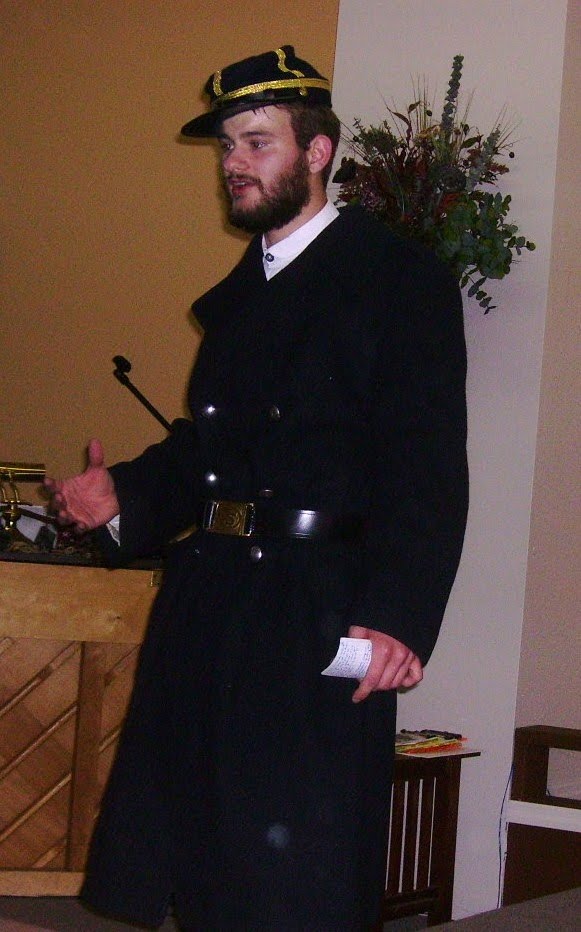
  Another exciting aspect of these trips was in Springdale, when I was able to debut as Max Rossvally, a Union surgeon in the Civil War. Rossvally was a devout Jew who hated Jesus with a passion. One day, he met Charley Coulson, a wounded drummer boy who was brought into his field hospital. Charlie's testimony of faith would change Rossvally's life forever. Because of the witness of one young drummer boy, Rossvally became a devoted Christian and a world-wide evangelist!

  I was unable to get many photos at the homeschool conferences (I didn't bring my photographer), but here are some of my trip to the Bartlett Senior Citizen's Center on July 30th, where I met many clever history and genealogy enthusiasts.

  Currently, I am in my second week of school, and am putting my nose back to the grindstone. If all goes well, I will finish this semester. I'm looking forward to dedicating more time presenting the Gospel through living history.

Thursday, July 15, 2010

On Historical Fiction


  Historical fiction is a great medium to connect with kids in a fun and exciting way while still teaching about historical events and encouraging Christian values. Someone asked me recently, however, if historical fiction will not only confuse our history more than it already is?

The “Civil War,” or War of Northern Aggression, is definitely a confused time in history. Will taking liberties with history or simply writing from a point of view as all authors do, skew the picture even more? I would like to propose that historical fiction clarifies the picture. For example, historical fiction touches on the spirit of the time. It shows how the people felt about what they were experiencing and allows the reader to lose their 21st century frame of reference. Just as one must understand the culture when he visits a foreign country, one must also understand the culture of a historical time if he hopes to understand it. At best, textbooks recount facts and dates and who did what. Historical fiction should expound on “who felt what” and explain WHY so-and-so did such-and-such. Why did the South believe they were doing the right thing?

If we look back at history, we will find many important writings that employed fictional people to convey real-life lessons. Take, for example, Baron de Montesquieu. He was the same man who wrote Spirit of the Laws in 1748 and was one of the philosophers from which our founding fathers drew the idea of governmental checks and balances. Montesquieu also wrote another work called Persian Letters. This work included fictional letters from two Persians who wrote home about England's constitutional form of government. His readers could learn about his revolutionary ideas of government while not feeling like Montesquieu was giving a lecture. They were reading someone's personal letters. Many of you will doubtless remember Candide, a novel in which the French philosopher Francois Voltaire encouraged the use of Enlightenment principles through the use of a contrived story. Or how about the Civil War-era author Harriet Beecher Stowe who wrote Uncle Tom's Cabin? President Lincoln said this novel started the war. While we do not agree with many of these authors, they do represent a good example of writers who taught non-traditionally---who taught without teaching. But perhaps our best example is the Lord Jesus Christ, Himself, who frequently utilized fictional parables so that “those that have ears” will hear, and those that don't have ears, will not.

Lastly, we do not write historical fiction with the purpose of taking the place of textbooks or historical documents. We use historical fiction as a persuasive medium, yes. A writer's goal is to persuade. But we also write historical fiction with the hope that it will encourage more people to delve deeper into history---to bring the past to life, to bring an understanding between our culture and theirs. And maybe, if we are successful, our readers will be inspired enough to study further and form their own perspective of the past.

Wednesday, July 14, 2010

4-H


  Okay, I'm finally getting these events loaded up. May 7, I spoke at the BWC 4-H Club meeting at Faith Baptist Church in Germantown, TN. The kids were electing new officers for their club, and I was honored to share with them a little about the history of the War for Southern Independence. Pictured here are some of the young people including my cousins who are part of the group.

  The Orphan and His Golden Bars was released last month, and we look forward to seeing the results of this project! We have already received a good response from several home-school meetings we attended. I was also excited to place my books on Amazon.com where they are now available for sale. They are also now as available on my website, www.southerncadencepress.com.

Saturday, May 1, 2010

Upcoming Events


The Orphan and His Golden Bars is at press! After much sweat and toil, I am pleased to announce that the continuing story of Roger Mills the drummer boy will soon be available for sale. Thank you all for your patience in waiting for this project, and I hope you enjoy it!

  I also hope to see you at the Searcy Homeschool Conference on May 14 and 15 at the Harding University Campus in Searcy, Arkansas. We will have a booth set up in the vendor area where I will be available to sign books. Also, I will speak at 9:30am on the drummer boy, and again at 2:15pm on "A Passion for Christ," where I talk about my writing experiences and how young people can discover their calling and follow the Lord.

We have two more events this month. I will speak at the BWC 4-H Club meeting in Memphis, and the Education Alliance Homeschool Conference in Springdale, Arkansas on May 14th and 15th. See you there!

Saturday, March 6, 2010

Description

(Illustration from The Orphan and His Golden Bars. That is Stonewall on the left who is directing Roger to stop the troops at Chancellorsville.)

I've been working on the cover for the sequel to The Orphan and the Beaten Drum. Below is the description I have so far. Drop me a line and let me know what you think.

The drummer boy returns in this poignant tale of the Confederacy’s last days. The army has just broken winter camp and is ready to fight. Back in the saddle, Roger Mills is now an officer on Stonewall’s staff, and his sister Jane is recruited into a Richmond hospital governed by an unusual Captain named Sally. On top of it all, Moss Neck hosts a charming wedding for two of Roger’s dearest friends, complete with music, dance, and baseball.

The South seems to stop her enemies at every contest. Yet, several crippling losses cause the army to slacken pace. After watching a slaughter at Gettysburg, Roger learns that his sister is deathly ill from her work at the hospital, and he is confronted with a heart-wrenching test of faith. Then, after a grueling winter when leaders are dead, supplies are down, and food is scarce, everyone knows their final chance is a last-ditch thrust into the enemy’s position. The lot falls to Roger and his corps. This is a story of faith and freedom; love and loyalty. It is the story of an orphan and his golden bars!

“I want to personally thank Bryce for undertaking such a noble project so that future generations will hear the stories of Pendleton and Jackson and their men. Also so that they will understand the true history of the men who wore the gray and fought for the South so long ago!” - W. Danny Honnoll, President of Arkansas Heritage Trails and Former Sons of Confederate Veterans Division Commander (from the Foreword).

Friday, March 5, 2010

Maynard, AR


It was "Book Character Day" on Tuesday, March 2. I arrived at Maynard Elementary about 1 o'clock and unpacked my gear. The kids were watching a Dr. Seuss video in the cafeteria in honor of the author's birthday. After setting up a table, I sat on the stage sipping a koolaid and watching a video about the Grinch. Not a bad start for the day. I began wondering if I could attend school there until they told me it wasn't always this fun.

I spoke to the K-6th graders. It was enjoyable to speak to this energetic and polite group of young people. When I asked them who liked to write, almost all of them raised their hands. Among the group, I was able to meet a few aspiring writers, including one girl who liked to write books and had been recognized by Williams Baptist College. I also had the opportunity to reunite with some friends who live in the area. My appreciation goes to the school, especially Melinda Harris the GT teacher, for inviting me out.

After I spoke, I left to check on a rental home we have in Pocahontas. I decided to burn a sizable pile of trash and branches that some renters left and that was becoming a real eye-sore. When a nearby tree started to catch fire, however, I decided it wasn't a good idea after all. It was tense moment, but I eventually tamed the fire. Yes, sir, it was a blessed day.

Friday, February 5, 2010

Below is a paper that I wrote on my family's history since 1891, over 4 generations. At least this will disprove my grandfather's belief that he came over on the Mayflower. Actually, our first ancestor in America was John Chandler who came over to Jamestown, VA with Lord Delaware when he was just a boy. He survived the Jamestown Massacre or we wouldn't be with you today!


Throughout Your Generations
Chandler Family History from 1891 - 2008
By Bryce A. Chandler

Cicero Francis Chandler was born August 30, 1891 in Blackhawk, Caroll County, Mississippi, just outside Greenwood. His wife, Annie Inez Shipp, was born February 8, 1898 in Belzoni, Washington County, which is now Humphreys County. Cicero and Inez were married on December 2, 1917 in Greenwood, Leflore County, Mississippi, and had eight children: Thomas Cicero (T. C.) , Agnes May, Ernestine (Ernie), Walter Frank, James Richard (Jimmy), Llewellyn Arthur (Lou), Annie Frances, and Robert Louis who was born February 12, 1937. Robert was the only child born in a hospital. Cicero fought with the U.S. Army in France during World War I before receiving a medical discharge when he developed double pneumonia and tuberculosis of the lungs. In 1929, the bottom fell out of the stock market and unemployment rose drastically. During this Great Depression era, Cicero moved to Memphis to find better job opportunities where he could use his trade as a carpenter.

Not able to find sustainable employment in Memphis, the Chandler family moved again to Mickie in McNairy County where Cicero helped the Tennessee Valley Authority build the hydroelectric Pickwick Dam that was constructed between 1934 and 1938. While in Mickie, the family lived in a small rental home, and the children attended Mickie Consolidated School. After the completion of Pickwick Dam, Cicero took his family back to Memphis to a house on Douglas Street. Robert remembers how there were no jobs available, but two or three men in the neighborhood would compile their money together in order to purchase food for the other families. With the start of World War II, the economy began to improve.

After Douglas Street, the family moved to a rental at 1057 Springdale. While living there, Robert often attended the Lucianne theater with his brother and sister on Saturdays. The theater showed anything from cowboy and war pictures to Humphrey Bogard and mysteries, but at the time, Robert mainly went to see the cartoons such as Snow White and Pinnochio. Before the pictures, he remembers how they would always play the national anthem, then show an exciting advertisement on war bonds, with flying fighter planes. This was part of an over four million dollar governmental advertising campaign that swept through the nation and rallied Americans to support their country during the war, of which was said “no promotional campaign, commercial, governmental, or Goebbel’s has ever spread its basic message so broadly, so quickly.” In addition to war bonds, there were also other ways to support the war. If one brought a pound of copper for the war effort, he could get into the picture for free; otherwise, the picture costed a dime. “It was something back then,” Robert said about the war fever.

When the family left Springdale, Cicero purchased a house at 614 North 7th. It was a big house, especially for the time, with 17 rooms and 4 bathrooms. They lived here for many years, and Robert remembers that his mother would hang a flag with two stars in the front window. The stars were for Robert’s older brothers Jimmy and Walter who were in the Pacific Theater during World War II. Jimmy helped build the flag pole on Okinawa while serving with the Construction Battalion (called Seabees), who gained respect for their ingenuity in constructing everything from quonset huts to seaports. Walter fought with the U.S. Marines. Two others in the house were also away at war. Both Ernie and Agnes’s husbands were in the navy. Robert remembers when his mother received letters, there would be holes in them. The soldiers were not allowed to tell where they were or what they were doing, or else a censor would take scissors and cut out the jeopardizing information.

The Chandler family’s first car was a 1939 Oldsmobile. Robert remembers his family crossing a railroad track one night and being hit by a train. Thankfully, no one was seriously hurt, but they all spent some days in the hospital.

On Springdale, the Chandlers attended Little Flower Catholic Church, and on 7th Street, they attended Holy Names. At the time, there were not many mission groups, and no one really had time or money to do much besides raise their own family. To save money, Cicero worked a garden and had a flock of chickens at Springdale, besides his regular 6 to 7 day a week job. When he came home from lunch, he gathered the eggs and would sell them for 25-30 cents a dozen. Even so, Robert remarked that he never knew his family suffered financially. His parents never led on about it.

Cicero was a home repairman during the war. Then one day he walked in the house and declared, “Every building they build, they have to tear one down. I’m going to start a wrecking business.” And he made good his promise. He bought three houses for $200 a piece on Crump Boulevard and Somerville to tear down and use for material, and in 1946, started C.F. Chandler Wrecking Company. The company survives today in Memphis as Chandler Demolition and is being carried on by the third generation.

Despite the 1938 Federal Wage and Hour Law, when he was 12, Robert Louis would work the company payroll for 25 cents an hour. “You could do a lot on 25 cents an hour,” he said, in a time when gas was less than 20 cents a gallon. By the time he was 15, he was driving a truck on the job site, even though he didn’t have a license yet. He ran his first crane in 1960 when he was 23 or 24. Robert’s first car was given to him by his father, and he took over the note. It was a sharp Royal Blue 1955 Dodge with a white top. Robert said his parents never wanted to control his future, but if there was something they would have liked him to be, it was a lawyer. He went 3 years to college. When asked what he wanted to be when he grew up, he said he never remembered wanting to be anything other than what he was.

Robert met his first real friend, Ronnie Averwater, in 2nd grade. In high school, he met Harry Debandi (now a doctor in Madisonville, Kentucky) who became a life-long friend with whom he still keeps in contact. Once, a friend of his, Eve Bennet, arranged for him to go on a blind date with Marilyn Mills, a Methodist girl who came up from Yazoo City, Mississippi. Her father, also named Robert, ran the Memphis oil refinery that is Valero today. This blind date turned into romance. Robert and Marilyn were married on October 4, 1958 at 7 pm in the chapel behind Grace Saint Luke’s Episcopal Church. Marilyn, who was 19, was too young under state law to marry without parental consent and her mother signed for her. Robert was 21.
(Robert and Marilyn Chandler, circa 1967).

The couple first lived in a small duplex at 1106 N. Garland where their first child, Pamela Diane, was born on July 25, 1959. From here, they moved to a house on 1457 Fox, and later moved to 2972 Estes, where their other three children were born. Dawn Denise was born August 22, 1962 and passed away unexpectedly from a heart attack on June 6, 2005 at the age of 42. Robert said losing a child was the hardest thing he had ever experienced. Robert Louis, Jr. (Robbie), was born December 29, 1963; and Christopher Mills was born April 28, 1969. All the children started school at Fox Meadows Elementary School, and then Grace St. Luke’s Middle School. Dawn went her senior year to Evangelical Christian School (ECS). During his high school years, Robbie attended Christian Brothers High School (CBHS).

(Robbie at 2 1/2 months, March 19, 1964).

Cicero died July 25, 1962 in Memphis from cancer of the lung. He asked to be buried with his feet to the east so that when Christ returned he could rise up and look Him in the eye. On April 4, 1968, Martin Luther King, Jr. was staying at the Lorraine Motel in Memphis to support a local strike by black workers. As King stood on the balcony, he was shot and killed by assassin James Earl Ray. At the time, Robert was working on Main and Beale, just two blocks away from the shooting. When Robert’s mother heard of the assassination of Dr. King, she became anxious with worry for her son and suffered a fatal heart-attack. She died April 13.

In the mid-70's, Robbie remembers his Dad breaking out on his own to start an excavating company where he worked on parking lots, tennis courts, and drive ways. For two years, the business flourished, and he received more work than he could perform. Then, the 1970's recession hit when Robbie was in 3rd or 4th grade, and his Dad “lost a lot.” But Robbie proudly told how his Dad did not claim bankruptcy but “worked a deal and paid back every dime he owed.” It wasn’t easy. He worked two and three jobs at a time. In the evenings, he worked at the Pancake House, and he worked maintenance at Grace Saint Luke’s before he went to work at wrecking jobs.

(Chris, Robbie, Pam, and Dawn in December, 1969).

Robbie does not remember his grandparents except for Francis Mills, his mom’s mother whom he saw often. One special memory is that she always kept her Bible on a wooden stand in her house. He never mingled much with his cousins on the Chandler side, and it became a family proverb that “they only got together on weddings and funerals”. On the other side of the family, however, it was a little different. When he lived in Memphis, Uncle Marvin Mills, a cardiologist, and the cousins would all gather at Robbie’s house on Thanksgiving. Later, however, Marvin’s family moved to Chattanooga, Tennessee. Robbie’s dad, Robert, coached his baseball and basketball teams at Grace Saint Luke’s and took him fishing. He worked on cars, even though he hated it. He also did some yard work when he had the time. Robert was good at golfing and bowling, and was very big into the latter. Robbie’s mom never worked outside the home, and was fully occupied raising her four children. She cooked almost every night until the kids got involved in high school sports. Marilyn drove them to all their sport events, “sometimes two or three a day,” Robbie said. She also took care of writing the bills.

They went to church at Grace Saint Luke’s Episcopal where Robert served as an usher. Robbie said he hated going to family weddings because the Chandler side were Catholic and their ceremonies lasted for a long time. Due to this, Robbie and his two sisters vowed never to get married in the Catholic Church. Ironically, they all married Catholic spouses, but not in the Catholic Church. In the 70's, the Chandlers built an addition on the house at Estes, where Robbie’s room would be.

For entertainment, the family had their sporting events. Robbie played baseball, basketball, and soccer. Robbie won his high school’s Athlete of the Year award in1978-79. At 14, his brother Chris won the National Junior Putt Putt competition and he helped his cheerleading squad win the national championship. They also watched the popular TV shows of the day like Happy Days, Dallas, Knott’s Landing, and Mission Impossible.

Robbie remembers neighbors on each side of his house—the Longs and the Walters. He was good friends with Toby Walter until Toby’s parents were transferred and they moved away. Another friend was Bret Leppard who lived in his neighborhood. Robbie would go to his youth group sometimes, and they remained friends until they were 15 or 16 years old when Bret got on drugs. His best friend was Curtis Motley when he was about 12 or 13. When they were young, the duo would do almost everything together—including taking trips to the hospital to get stitches every week after climbing trees or failed attempts at riding their bicycles down a slide. His sister was also Dawn’s best friend. Eventually, Curtis’s parents were transferred to Houston, Texas where they bought a big house with a swimming pool. Robbie and Dawn visited twice, but soon lost contact with them.

(Robbie and his grandmother, Francis Mills, when he graduated college).

Robbie attended Christian Brothers College where he received a Bachelor in Accounting. In 1986, he worked for Motorola, and eventually, he worked many years as a business manager in the building products industry. While working at Putt Putt Golf and Games in Memphis when he was in highschool, Robert met fifteen year-old Tamara Slinkard who had come to Putt Putt with a church youth group. Robbie gave her some free tokens for the machines. “I always liked a bargain,” Tamara said, and she was hooked after that. Five years later, the couple was married at Holy Communion Episcopal Church on August 9, 1986.

(Bryce and Brandon, circa 1990).

Their first child, Brandon Michael, was born at Baptist Memorial Hospital in Memphis on May 26, 1987. Bryce Andrew was born November 22, 1989, also at Baptist. Robbie worked at Amoco and was transferred to St. Louis when Bryce was just a baby. They lived the typical suburban family life at a house on 109 Bonnybridge Court in Ellisville, West County, Missouri. Here, Robbie and Tamara attended Gateway Christian Church, where they made a profession of faith in the Lord Jesus Christ and were baptized. They also decided to home-school their children, a unique practice at the time that has grown over the years. They met the Billings family who lived in Arnold, became fast friends, and still keep in contact today. Mikey and Jamie would prepare for the annual speech competitions with Brandon and Bryce, and the boys played several years on roller-hockey teams. They also met at each other’s homes or at the park for home-school get-togethers, or attended field-trips. Once at a park, Brandon was attacked by a swarm of yellow jackets, and Mikey came to the rescue by trying to swat them off. They both wound up side by side in the emergency room. On November 4, 2007, Mikey was killed in an automobile accident in San Antonio, Texas. The Chandlers also became the assistant leaders of the West County Christian Home Educators. They became friends with the leaders, the Muller family, and a highlight of their home-school meetings was a visit to Steak-n-Shake afterwards with all the kids.

(Jamie and Mikey Billings with Brandon and Bryce at a Civil War re-enactment in Pilot Knob in 2004).

In 1997, the Chandlers decided to move rurally, and purchased 70 acres on Pike County Road 223, north of Troy. Pike 223 was right down the road from a town called Paynesville with a population of 60. All that was there was a soda machine that people kept robbing. Bryce remembers that the last time he saw the machine it had a note warning people that if it was robbed again, then it would be taken away. The Chandlers bought a small Shetland Pony that they named “Trigger,” after Roy Roger’s Palomino. He was ornery at first, and even threw Tamara when she was pregnant. But Brandon was able to break him into a gentle ride. The Chandlers enjoyed their property, but didn’t know much about living in the country. A neighbor, Carl Brune, who ran a cattle farm, often helped them learn the ropes. During the winter, he would plow them a driveway through the snow, and during the summer, he would help them with fencing. Miss Linda owned a 16 hand Tennessee Walker, and the boys would sometimes ride “Trigger” with her. Carl would also take the boys on inner-tubes on a track he had made in the snow, pulling them behind his 4-wheeler for a wild ride.

The Chandler’s also would hunt on their land, but never shot anything accept chickens. Other friends who came up from St. Louis to hunt would bag a deer, one of them a fifteen-point buck. Once, the Chandlers bought several chickens that turned out to all be roosters. They became wild and would roost in the trees at nights. Eight year-old Bryce asked his mom if he could try and shoot one, and she answered “yes,” not thinking he would hit it. Bryce took his pellet gun and stalked one of the roosters to the creek, took aim, and hit it in the back of the neck with the first shot. Shocked, his mom scrambled for the book to find out how to pluck a chicken; that night, they had chicken soup. Brandon and Bryce enjoyed dressing up and playing guns in the woods. They would climb up the steep hills and wade in the creeks. They also fed the animals, built the corral out front, and did fencing. They helped Carl Brune haul hay in the summer, and they put siding on their double-wide before they moved away. It was here, too, that Bryce accepted Jesus as his Savior.

As the roosters crowed outside, Blake Christopher was born at home September 9, 1998, leaving a nine-year gap between him and Bryce. The day before Blake was born, Mark McGwire had hit his 62nd home run, breaking Roger Maris’s record. The St. Louis area was wild with excitement, and subsequent articles in the Post-Dispatch ran headlines like “Swing King. Amazing! Even the slugger can’t believe he did it!”

In 1999, the Chandlers wanted to get closer to their family in Memphis, so they moved to 803 Leewood Drive in Paragould, Arkansas, where they rented a small house in a neighborhood for a little over a year. Robbie and Tamara’s fourth child, Elizabeth Ann was born July 15, 2000 at St. Bernard’s in Jonesboro, Arkansas. Eventually, they moved to 11 acres at 451 Robinson Road, in Pocahontas, Arkansas right before Christmas and celebrated the holiday at their house with the relatives. Here in Pocahontas, the older boys did 4-H Shooting Sports, and both won many honors. One year, Bryce won 2nd, Brandon 3rd, and their team placed 1st in Pellet Pistol Competition. They also wrote articles for their local newspaper, the Pocahontas Star Herald, and Bryce took up writing the 4-H Limelight column after Brandon started it. On 9/11, Bryce watched the television in horror as the second plane slammed into the Trade Tower, and the country plunged into war. Little did he know that, seven years later, his own brother would join the Marines.
(The Chandler family at their home in Pocahontas, circa 2002. From Left: Bryce, Tamara, Blake, Robbie, Elizabeth, and Brandon).

The family attended Beautiful Gate Baptist Church in Horseshoe Bend, Missouri and became firm in their stance on Bible doctrine, and how a sinner must repent of his sins and trust in the finished work of Christ in order to be saved, and how it is not of any works of his own. For, “not by works of righteousness which we have done, but according to His mercy He saved us....” Later, they began attending Gethsemane Missionary Baptist Church in Walnut Ridge, and Robert and Bryce took classes at Gethsemane Bible Institute. Bryce also published two books on the Civil War and presently travels to schools and libraries to represent the drummer boy’s life. He is pursuing an online degree from the University of Arkansas at Little Rock.

America has changed drastically since Cicero Chandler was born in the late 19th century. The new millennium has emerged from a troubled century with a Great Depression, two world wars, and a crisis over civil rights. The new generation has suffered very little of these burdens, but trials of the new century continue to loom overhead. With the continuation of the War in the Middle East, a gathering financial crisis at home, and an African-American in the White House, the 21st Century appears a typical, yet very unique era of the American experience. Just what is in store for this new generation is mere speculation.

Saturday, December 19, 2009

Wow, it has been a while since I have posted here. I have a lot to catch up on, and many events to talk about. Unfortunately, I did not take many pictures! However, since I last posted I have made another trip to Fayetteville, as well as one to Kansas City, Missouri and the Robert E. Lee Camp of the SCV in Germantown, TN (April 23). I also spoke at the MHEA Homeschool conference in the summer (June 12-13).

At the MHEA Conference, I was blessed to be able to share a new topic about my experiences as a self-published author. It is easy to try to do good things for God, but it is a lot harder to let God do good things through you! Yielding is the main objective of the Christian life, but it is often overlooked. This is the topic I discussed with the students of Fayetteville Christian school on my return visit in August, and also to the 4-H Honor Society in Memphis on August 8.

In Kansas City in September, it was wonderful to be able to fellowship with another homeschool family who opened their home to us. Although it was only for one night, we had a good time watching their son perform magic tricks, discussing many topics, and of course, eating cinnamon rolls!

I have also been busy finishing up The Orphan and His Golden Bars. It is the sequel to The Orphan and the Beaten Drum. I hope to get it to the presses sometime in the next couple of months. We are excited to see how God will use this book to minister to hearts and spread His truth. A friend and compatriot of mine, Danny Honnoll, has written a Foreword to the book, drawing from his recent travels to Virginia and the place where Stonewall Jackson died. It is a real honor to have Mr. Honnoll's encouragement in this endeavor. He is the President of Arkansas Civil War Heritage Trails and the former commander of the Arkansas Sons of Confederate Veterans. He is also presently running for the office of commander of the Trans Mississippi Division SCV. You can check out his website at Honnoll.com.

Besides all this, I have been taking online classes from the University of Arkansas, and hope to graduate next year. Also, I have been working at getting some freelance material published. My work was recently published in Nature Friend Magazine, and another article will appear soon in The Storyteller. Hope to see you in Springdale and Searcy, at the Arkansas Homeschool conventions this summer! Drop me a line when you can.

Wednesday, May 6, 2009

Fayetteville, Arkansas


Wednesday (April 22), I visited Northwest Arkansas. I spoke at the Washington County Women's Republicans and talked about the drummer boy's life and the similarities between the War Between the States and the American Revolution. On Thursday, I traveled to Fayetteville Christian School and spoke with the young people in the adjoining auditorium at Mission Boulevard Baptist Church. It was a very productive trip, and we also enjoyed meeting with friends in the area and watching them cut down a hollow cedar tree!
Below, I am playing the fife for the Washington County Republican Women.


Today, I just got back from court where I disputed an expired tag ticket that I got one evening. I always find it fascinating standing before a judge. We had to sit for a long time waiting on him, and then when he appeared, we rose to honor him and waited for him to meet out justice. It is very symbolic of what it is like waiting on Christ, the Righteous Judge, to appear. I have also been studying for final exams, which are nearly over for this semester. I'm looking forward to the summer where I have a lot of fun planned taking CLEP exams.

Watch for us next in Germantown at the meeting of the Sons of Confederate Veterans!

Sunday, April 12, 2009

Genealogy Road Show


The rain did not stop us Saturday (March 28), at the Genealogy Road Show in Paragould. Above, members of the Shaver Camp, Sons of Confederate Veterans, and I are placing the flag for the Pledge of Allegiance. We all had a great time at the Community Center, where I presented the life of the drummer boy and several others spoke on historical themes. We also manned booths and talked with the public as they came through to view Civil War paraphernalia, arrowheads, and other historical objects. My thanks goes to the Greene County Historical and Genealogy Center who hosted the event!


I will be speaking next in Springdale, Arkansas at the Women's Republican Meeting on April 22 at 11:30am and Fayetteville Christian School on April 23, from 10:55 to 11:47am. Look forward to seeing you there!

Tuesday, March 31, 2009

Sons of Confederate Veterans


Thursday (March 26), I was in Little Rock at the Fletcher Library and attended the meeting of the Newton Camp, Sons of Confederate Veterans. I gave a presentation on the drummer boy, and also "If My People" on the similarities between the Revolution and the War Between the States. My appreciation goes out to the commander Corey Dunn (far left) and all the gentlemen of the camp for their Southern hospitality.


Meanwhile, I am finished writing the sequel to The Orphan and the Beaten Drum. Now, it will go into the editing/proofing stage. Hopefully, I will have it out this summer, so be looking for that. I'm also excited about making a video on "how to make a drum" to load to my blog. Make sure you view that when it comes out.
See you in Northwest Arkansas on the 22nd!

Monday, January 12, 2009

Germantown, Tennessee


On Saturday (January 10), I spoke at the Germantown Regional History and Genealogy Center. The Center was holding a history program and Harry Cloyes, a long-time Germantown resident, displayed his paintings of historic buildings. Rick Cohen also spoke about the life of a Civil War soldier. Pictured above is Rick Cohen, me, Jennifer Baker of the Center, and authors Jama and Charles Richardson.

Watch for my demonstration video about A Courier for Stonewall, The Orphan and the Beaten Drum, and my living history presentations. It will soon be available online.